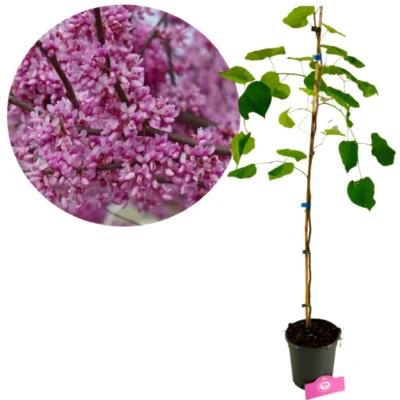
Cercis siliquastrum, better known as the Judas tree, is a remarkable ornamental tree native to the Mediterranean region, best known for its spectacular spring blossom. Even before the leaves appear, the bare branches and even the trunk can become covered with clusters of purple-pink flowers. This gives the tree a very different appearance in spring compared to most other flowering garden trees.
Even after flowering, the Judas tree remains decorative. The round to kidney-shaped green leaves form a broad, airy crown, and later in the season flat pods appear which can remain on the tree well into winter. Due to its natural, irregular growth habit, the plant can develop into a sturdy shrub or a distinctive multi-stemmed tree.
Why choose Cercis siliquastrum?
• Striking purple-pink flowers that appear before the leaves develop
• Flowers even appear directly on older branches and the trunk
• Characteristic round to kidney-shaped leaves
• Develops a broad, natural and often multi-stemmed growth habit
• Highly resistant to heat and drought once established
• Valuable spring blooms for bees
Contents of this product
• 1 x Cercis siliquastrum – Judas tree
- Pot size: 2 litres
• Height on delivery: approx. 60–80 cm (approximate)
The tree is supplied in a nursery pot and will continue to grow after planting. The stated height on delivery is approximate and may vary slightly depending on the season, pruning and stage of growth.
On growth and exceptional flowering
Cercis siliquastrum can eventually grow into a tree approximately 6 to 10 metres tall and often develops a broad, irregularly rounded crown. The species can be grown both as a single-stemmed tree and as a multi-stemmed specimen.
The most remarkable moment is when it flowers in spring. The purple-pink flowers appear in compact clusters before the foliage has fully developed. It is striking that the flowers do not only appear on young twigs, but can also emerge directly from older branches and even from the trunk. This phenomenon is known as cauliflory and gives older Judas trees a spectacular appearance.
After flowering, the characteristic round to kidney-shaped green leaves appear. Later, flat brown pods about 10 to 12 cm long may develop. These often remain on the bare branches throughout the winter.
The Judas tree is deciduous and is therefore bare of leaves in winter.
Care
The Judas tree is native to the warmer regions around the Mediterranean and therefore prefers a sunny, warm and sheltered spot.
Well-drained soil is important. This species grows well in calcareous sandy and loamy soils and tolerates drought reasonably well once its root system has developed. Soil that remains wet for long periods is less suitable.
Water young trees regularly during dry spells. Once it is well established, the Judas tree can cope with drought much better.
Prune
Cercis siliquastrum naturally requires very little pruning. It is precisely its somewhat erratic, spreading growth that gives an older Judas tree its characteristic appearance.
If you do wish to shape the tree, limit pruning mainly to damaged, crossing or unwanted branches. The plant can also be trained against a warm south-facing wall, where it will benefit from the extra warmth and shelter.
Winter care
Once well established, Cercis siliquastrum is hardy and can withstand temperatures of around -18 to -20°C. Young trees, in particular, are, however, more susceptible to severe frost.
We therefore recommend planting young plants in a warm, sheltered spot. Protection from cold easterly winds is particularly beneficial during the first few winters. In the event of severe frost, the base of young plants can be covered with a layer of mulch if necessary.
As the tree grows older and stronger, it becomes better able to withstand cold winters.
A special flowering tree for a sunny garden
The Judas tree is particularly appealing to anyone looking for an ornamental tree that really stands out. The combination of flowers against the bare wood, the rounded leaves and its natural multi-stemmed growth make it a stunning specimen tree in a sunny spot.
Cercis siliquastrum also combines beautifully with other heat-loving and Mediterranean plants. Take a look at our other ornamental trees and Mediterranean garden plants to create a sunny garden featuring a variety of flowering periods and foliage textures.



 Free Free home delivery from €60,- Minimum order of €15!
 Nederlands
 Deutsch
 Dansk
 Français
 English (UK)
 Svenska