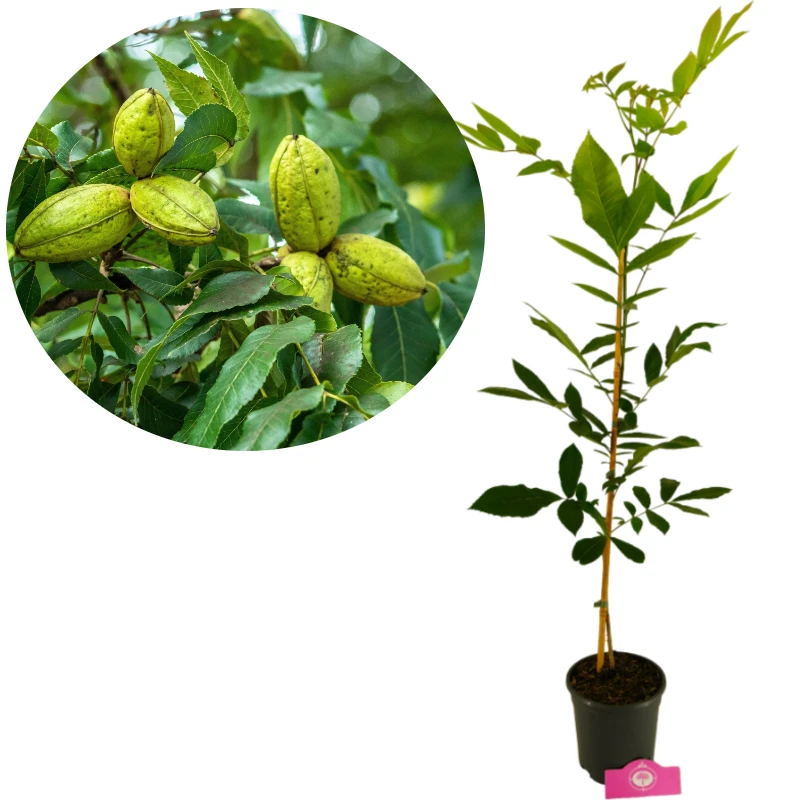
Carya illinoinensis - Pecan tree - Height 90 cm - 3 litre pot
The Carya illinoinensis, or pecan tree, is an imposing deciduous tree in the walnut family (Juglandaceae), originating in the southeastern United States, particularly in Illinois. This tree is known for its edible nuts and its great, decorative value in spacious gardens, orchards or parks.
Growth form and appearance
Carya illinoinensis eventually develops into a broad park tree with a round, airy crown and overhanging branches. In the first 10 years, it reaches a height of about 6 metres. Mature specimens can eventually grow more than 20 metres tall and wide. The pinnate leaves are remarkably large - up to 30-40 cm long - with elongated, narrow, light green leaves that turn to warm yellow-brown in autumn.
Flowering and pollination
Flowering takes place in April to May with inconspicuous, yellow-green flowers. The tree is monoecious: male and female flowers appear on the same plant and are wind-pollinated. Although this seedling (variety ‘Carlson’) does not produce huge nut crops immediately, the first fruits can be harvested as early as the fourth year appear. For reliable yields, a second pecan tree nearby is recommended for cross-pollination.
Fruit
The pecans appear in clusters enclosed in elongated, leathery husks that spring open when the nuts are ripe (often in October). The smooth, reddish-brown shell reveals the familiar elongated nut with a creamy, sweet flavour. Pecans are delicious raw, but also very popular roasted or in cakes, desserts and salads.
Location and care
-
Light: full sun
-
Bottom: humus-rich, moist but permeable
-
Water: likes moist soils, give extra water in case of drought
-
Hardiness: moderately hardy to about -12 °C (zone 8a)
-
Prune: in early spring (February-March) to maintain shape
-
Particulars: deep root system - do not transplant after establishment
Although Carya illinoinensis is moderately hardy in its young years, it gets stronger with time. Young trees can benefit from winter protection, especially at temperatures below -10°C.
Use and application
This pecan tree is ideally suited for:
-
Food forests and edible gardens
-
Spacious gardens and orchards
-
Natural landscapes and parks
-
Long-term nut production
The tree not only contributes to biodiversity, but is also very valuable as a food crop and as an ornamental tree with high ecological value.
Note: Since pecans need cross-pollination, it is recommended to plant at least two Carya illinoinensis trees for a reliable harvest.


 Free Home delivery from €60 minimum order value €15

 Nederlands
  Deutsch
 Dansk
Dansk
 Français
 English (UK)
 Svenska