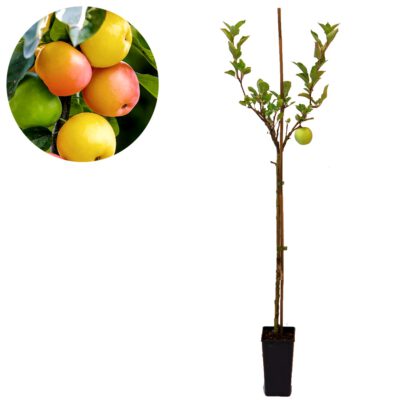
Cydonia oblonga, better known as the quince, is a distinctive fruit tree with a natural, compact growth habit, relatively small leaves and large, aromatic fruits. This specimen is not grafted but grows on its own roots. As a result, the tree develops naturally and there is no graft union.
In spring, beautiful pale pink to almost white flowers appear. Later, the characteristic golden-yellow quinces develop. When ripe, the fruit gives off a strong, pleasant scent and is mainly used to make, amongst other things, jelly, jam, compote and other quince products.
Why choose Cydonia oblonga?
• Ungraffed quince on its own roots
• Natural and relatively compact growth
• Attractive, relatively small leaves
• Light pink to white spring flowers
• Large, golden-yellow and highly aromatic fruits
• Fruit that is ideal for processing
• Very hardy
Contents of this product
• 1 x Cydonia oblonga – quince
- Pot size: 5 litres
• Height on delivery: approx. 80–100 cm (approximate)
• Ungrafted: grows on its own roots
The tree is supplied in a nursery pot and will continue to grow after planting. Its height, branching and foliage may vary depending on the season, pruning and natural development.
Un-grafted quince growing naturally
This Cydonia oblonga has not been grafted onto a different rootstock. The trunk, branches and roots therefore all belong to the same plant.
The tree naturally develops a compact, bushy to small-tree-like habit. Depending on its location and pruning, Cydonia oblonga can eventually grow to a height of around 3 to 5 metres.
The relatively small leaves give the tree a delicate and well-groomed appearance. Thanks to its natural branching, it can be grown either as a compact fruit tree or as a multi-stemmed specimen.
Flowering and quinces
In spring, attractive flowers appear in soft shades ranging from white to pale pink. These are larger and more striking than the blossoms of many traditional apple and pear trees.
Following successful pollination, the quinces develop throughout the growing season. As they ripen, they turn yellow to golden yellow and give off their characteristic, strong aroma.
Quinces are hard and are not usually eaten straight from the tree, as apples are. When cooked, they develop a delicious, aromatic flavour and are ideal for making jelly, jam, compote, desserts and other dishes.
Location and care
Quinces grow best in a sunny, warm spot. They can also tolerate light partial shade, but sufficient sun helps with flowering and ensures the fruit ripens properly.
Plant the tree in nutrient-rich, humus-rich and well-drained soil. The soil should retain sufficient moisture, but the roots must not be left waterlogged for long periods.
Water young and newly planted trees regularly during dry spells. In spring, you can apply compost or organic fruit tree fertiliser to support growth and fruit development.
Prune
Cydonia oblonga does not require heavy annual pruning. Allow the tree to develop its natural compact shape as much as possible.
Remove damaged, crossing or inward-growing branches to ensure there is sufficient light and air within the crown. If desired, the tree can be kept compact with light pruning.
Winter care
Cydonia oblonga is highly hardy and well suited to the Dutch climate. The tree is deciduous and stands bare throughout the winter. In spring, fresh foliage reappears, followed by flowering.
Once it is well established, no special winter protection is usually required.
For lovers of unusual fruit trees
The quince is an excellent choice for anyone who, as well as apples and pears, wishes to grow more traditional and less common varieties of fruit. The combination of compact growth, beautiful spring blossoms and large, aromatic autumn fruits gives this tree both ornamental value and edible benefits.



 Free Free home delivery from €60,- Minimum order of €15!



 Nederlands
 Deutsch
 Dansk
 Français
 English (UK)
 Svenska