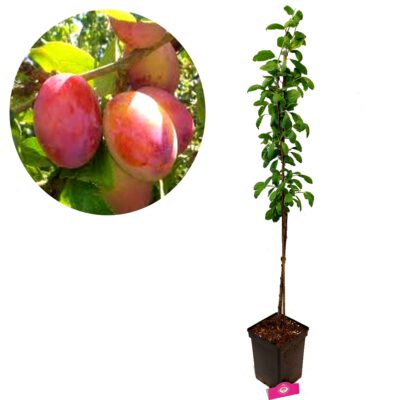
Prunus cerasifera ‘Myrobalan’, better known as the cherry plum or myrobalan, is a hardy and versatile tree that combines abundant spring flowering with edible fruit. Early in the spring, large numbers of white to pale pink flowers appear on the still bare branches. Later in the season, small, sweet plums may develop, ranging in colour from yellow to red.
The cherry plum grows naturally as a large shrub or small tree and can be cultivated in various ways. Thanks to its vigorous growth, good tolerance to pruning and dense branching, this species is suitable as a solitary ornamental tree, a natural hedge or for various pruning styles.
Why choose Prunus cerasifera ‘Myrobalan’?
• Abundant white to pale pink flowers in early spring
• Edible yellow to red cherry plums
• A strong and relatively fast-growing tree
• Suitable as a tree, large shrub or natural hedge
• Tolerates pruning well
• Valuable early flowering for bees and pollinators
- Good winter hardiness
Contents of this product
• 1 x Prunus cerasifera ‘Myrobalan’ – cherry plum
- Pot size: 5 litres
• Height on delivery: approx. 100 cm (approximate)
The tree is supplied in a nursery pot and will continue to grow after planting. Its height, branching and foliage may vary depending on the season, pruning and natural growth.
Growth and final form
Prunus cerasifera can eventually grow into a tree approximately 6 to 10 metres tall. The species develops a broad, rounded and somewhat irregular crown. Older specimens may develop a characteristic, slightly curved trunk.
The leaf is small, oval and green in colour. In autumn, the leaf changes colour before falling off.
The branches may develop short, thorny shoots. Combined with its dense branching, this makes the cherry plum an attractive choice for natural hedges and sheltered plantings.
Early flowering and edible plums
One of the most striking characteristics of the cherry plum is its early flowering. Large numbers of flowers often appear on the bare wood as early as March or April, even before the leaves have fully developed.
The flowers open white to pale pink and may have a darker pink centre. They attract bees and other pollinating insects that become active early in the season.
Following successful pollination, small, round plums measuring approximately 2 to 3 cm develop. The fruits can turn yellow, red or reddish-purple and are edible. The flavour ranges from crisp and sweet to pleasantly sweet and tart, depending on the ripeness and the individual fruit.
The plums can be eaten fresh, but are also suitable for making jam, compote and other dishes.
Location and care
The cherry plum grows best in a sunny to semi-shaded position. Plenty of sun promotes abundant flowering and good fruit development.
Prunus cerasifera is relatively undemanding in terms of soil and grows well in normal, fertile and well-drained garden soil. It will also tolerate slightly damp soil, provided there is no prolonged waterlogging.
Water young trees regularly during their first growing season. Once well established, the cherry plum can tolerate temporary dry spells more easily.
In the spring, compost or organic fruit tree fertiliser can be applied to support healthy growth and fruit development.
Prune
Prunus cerasifera tolerates pruning well and can therefore be trained in various ways. As a free-growing tree, it requires little pruning, but the species can also be grown as a hedge, screen or espalier.
Remove damaged, crossing or unwanted branches. Prune preferably during a dry spell in summer or after the harvest. Avoid heavy winter pruning to minimise the risk of infection through pruning wounds.
Winter care
The cherry plum is highly hardy and well suited to the Dutch climate. The tree is deciduous and loses its leaves during the winter.
Once the tree is well established, additional winter protection is not normally required. However, the early blossoms can be damaged by late night frosts, which may result in a lower fruit set in some years.
A versatile tree for gardens and the countryside
The myrobalan is an interesting choice for anyone looking for a tree that combines ornamental value, edible fruit and a natural growth habit. Its early flowering makes it valuable to pollinating insects, whilst the fruit is also eaten by birds later in the season.
Combine the cherry plum with other plum trees, flowering shrubs or fruit-bearing varieties to create a varied fruit garden, natural hedge or food forest.



 Free Free home delivery from €60,- Minimum order of €15!


 Nederlands
 Deutsch
 Dansk
 Français
 English (UK)
 Svenska