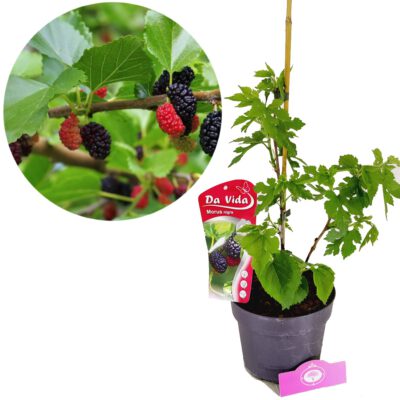
Morus alba, better known as the white mulberry, is a hardy and versatile tree that has been cultivated for centuries for its edible fruit and graceful growth habit. The species originates from Asia and is known for its large, often irregularly shaped leaves and its excellent ability to adapt to a variety of growing conditions.
As well as its ornamental value, Morus alba produces sweet fruits that resemble elongated raspberries. This makes the tree not only a beautiful ornamental tree, but also a valuable addition to an edible garden or food forest.
Why choose Morus alba?
• Sweet edible mulberries
• Decorative and often unusually shaped leaves
• A strong and fast-growing tree
• Suitable for food forests and edible gardens
• Tolerates pruning very well
• Very hardy
Contents of this set
• 4 x Morus alba – white mulberry
- Pot size: 9 cm
• Height on delivery: approx. 25 cm (approximate)
• Total number of plants: 4
The plants are supplied in a 9 cm nursery pot. These are young plants that will continue to grow after planting. The height on delivery is therefore approximate and may vary depending on the season and stage of growth.
About the Morus alba
Morus alba grows into a medium-sized to large tree that can eventually reach a height of around 6 to 12 metres. The tree develops a broad crown and can be allowed to grow freely, trained along a trellis, or grown as an espalier.
The leaves are a fresh green, glossy and often strikingly varied in shape. Some leaves are oval, whilst others may be deeply lobed. This gives the tree a playful and natural appearance.
In spring, inconspicuous inflorescences appear, after which edible fruits develop. The fruits resemble elongated blackberries or raspberries and have a pleasantly sweet taste when fully ripe.
In addition to its fruit, Morus alba is also valued worldwide as a food plant for silkworms.
Care
The white mulberry grows best in a sunny, sheltered spot. Generally speaking, the more sun the tree gets, the better the fruit will develop.
The tree is not particularly demanding in terms of soil and will grow in almost any well-drained soil. A slightly moist, nutrient-rich soil usually yields the best results.
After planting, it is important to water regularly until the plants are well established. Older trees are generally able to withstand temporary drought.
Prune
Morus alba tolerates pruning very well. This makes it easy to keep the tree at the desired size or to train it as an espalier.
Pruning is best carried out during the dormant period. Heavy pruning is usually well tolerated.
Winter care
The white mulberry is very hardy and can withstand temperatures down to around -28°C. Young plants may be slightly more susceptible to late spring frosts in their early years, but they usually recover well.
In winter, the tree sheds its leaves and sprouts new ones in spring.
Use of the fruits
The ripe fruit can be eaten straight from the tree and has a pleasantly sweet taste. It is also suitable for making jam, juice, desserts and other fruit-based dishes.
The fruit is often enjoyed by both people and birds.
For lovers of unusual fruit trees
Morus alba is an excellent choice for those who love unusual fruit varieties and food forests. The tree combines well with other fruit trees, nut trees and small fruit varieties to create a varied edible garden.



 Free Free home delivery from €60,- Minimum order of €15!
 Nederlands
  Deutsch
 Dansk
Dansk
 Français
 English (UK)
 Svenska