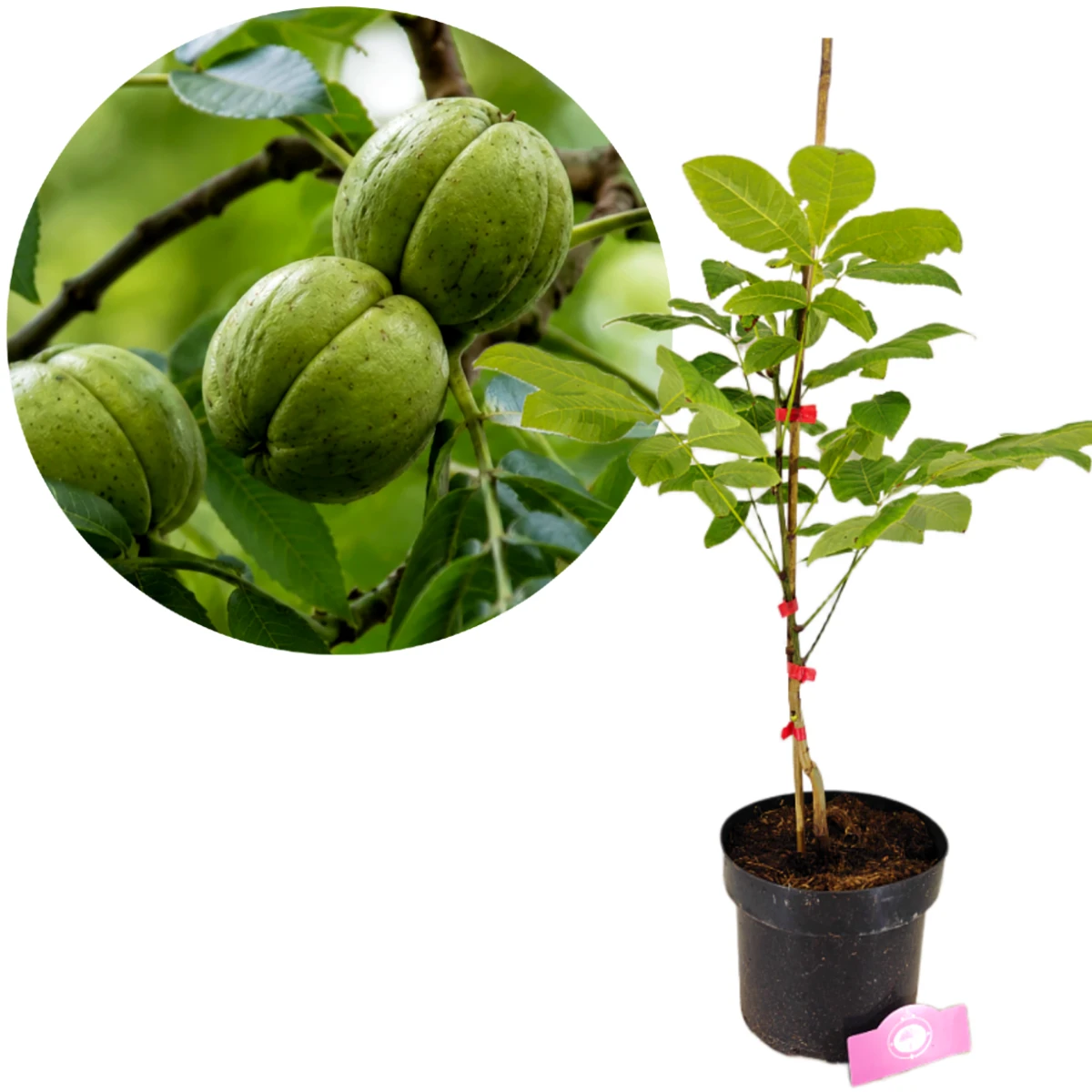
Carya ovata, also known as the white hickory or shagbark hickory, is an imposing nut tree native to North America. This species is renowned for its decorative bark, beautiful autumn colours and sweet, edible nuts.
As it matures, the tree develops a distinctive trunk, with the bark hanging from the trunk in long, loose strips. Combined with its broad crown and golden-yellow autumn colour, this makes the tree a striking feature in larger gardens or food forests.
Why choose Carya ovata?
• Sweet edible nuts
• Decorative hanging bark
• Beautiful golden-yellow autumn colour
• Extremely long service life
• A hardy tree species
• Suitable for food forests and large gardens
Contents of this product
• 1 x Carya ovata – white hickory
- Pot size: 5 litres
• Height on delivery: approx. 30–40 cm (approximate)
The tree is supplied in a nursery pot and will continue to grow into a large walnut tree after planting. The height on delivery may vary slightly depending on the season and stage of growth.
About Carya ovata
Carya ovata grows into a large tree, reaching a height of around 20 to 25 metres, with a broad, semi-open crown. The branches often grow in a slightly drooping manner.
The compound leaf consists of several elongated leaflets of a fresh green colour. In autumn, the leaves turn a striking golden yellow before the tree sheds its foliage.
One of the most striking features of older trees is the elegant texture of their bark. The bark peels away in long vertical strips, giving the tree a distinctive appearance.
The tree produces edible nuts that resemble small pecans. The nuts grow in clusters and usually ripen in October and November. When the outer shell splits open, the nuts are ready to harvest. They have a sweet and aromatic flavour.
Care
Carya ovata grows best in a sunny spot. The tree prefers nutrient-rich, slightly moist soil that remains well-drained.
On dry, sandy soils, watering the trees during hot summers can help young trees to thrive. When planting, compost or organic fertiliser can be added to improve the soil structure.
Given the tree’s eventual size, it is important to leave sufficient space around it.
Prune
Pruning is usually only necessary to a limited extent. If necessary, damaged or unwanted branches can be removed in early spring.
The tree’s natural growth habit is shown to its best advantage when it is largely left to grow freely.
Winter care
The white bitter nut is very hardy and well suited to the Dutch climate. It generally withstands temperatures well below -20°C.
How to use the notes
The nuts can be eaten fresh or used roasted in desserts, cakes or other dishes. Their sweet flavour makes them a popular choice as an edible nut for your own garden or food forest.
For lovers of unusual nut trees
Carya ovata is an excellent choice for those who love unusual nut and fruit trees. The tree combines ornamental value with edible produce and pairs well with other nut trees, fruit trees or food forest plants.



 Free Free home delivery from €60,- Minimum order of €15!

 Nederlands
 Deutsch
 Dansk
Dansk Français
 English (UK)
 Svenska